Beyond AI Agents. Toward AI Decision Intelligence.
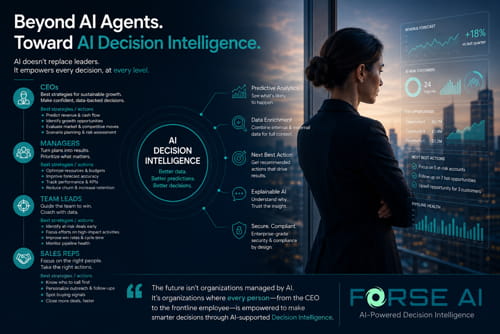
Everyone is talking about AI Agents. I think we're asking the wrong question.
Over the past year, it feels like every conference, article, and product announcement has been about AI Agents.
Can they write emails?
Book meetings?
Generate presentations?
Automate workflows?
These are all impressive capabilities, and they will undoubtedly become part of our everyday work.
But after speaking with business leaders across different industries, I've noticed something interesting.
Very few CEOs have asked me how many tasks AI can automate.
Instead, they ask questions like:
- How can we predict which customers are likely to leave?
- Where should our sales team focus their time?
- How accurate is our revenue forecast?
- Which market opportunities are we missing?
- How can we make better decisions with the data we already have?
These aren't questions about automation.
They're questions about decision-making.
And I believe that's where the real value of AI lies.
Not in replacing decision-makers, but in helping them make better-informed decisions.
Good leaders have always made difficult decisions with incomplete information. That isn't going to change.
Leadership is still about setting direction, understanding people, balancing risks, and ultimately taking responsibility for the outcome. AI won't replace that, nor should it.
What AI can change is the quality of information available before a decision is made.
Imagine starting your day with more than just yesterday's reports.
Instead, you see:
- which customers are most likely to churn,
- which prospects have the highest probability of converting,
- how your revenue forecast has changed - and why,
- where new growth opportunities are emerging,
- and which actions are most likely to improve business outcomes.
The decision is still yours.
But you're making it with better visibility, stronger evidence, and less uncertainty.
And this shouldn't stop at the executive level.
Every day, hundreds of decisions are made throughout an organization.
A sales representative decides which customer to call first.
A customer success manager decides which client needs attention today.
A marketing manager decides where to invest the next campaign budget.
A finance manager decides how to allocate resources.
A CEO decides where the company should invest next.
The quality of those decisions has a direct impact on the business.
Imagine if every one of those people had access to AI-powered insights combining historical business data, predictive analytics, external market information, and recommendations tailored to the way their company operates.
Not to replace their judgment.
To strengthen it.
That's why I believe the next evolution of AI isn't about building smarter assistants.
It's about building Decision Intelligence.
Technology that doesn't simply help people complete tasks faster, but helps organizations make better decisions - at every level.
From strategic decisions in the boardroom to operational decisions made by frontline teams every single day.
The future isn't organizations managed by AI.
It's organizations where every person - from the CEO to the frontline employee - is empowered to make smarter decisions through AI-supported Decision Intelligence.
