AI Isn't Replacing Intuition. It's Making Intuition Measurable.
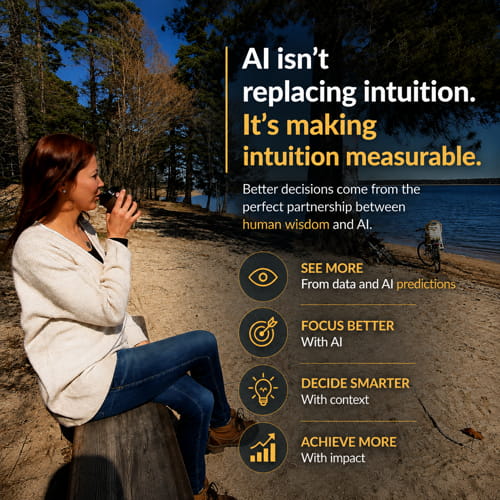
Better decisions come from the partnership between experienced human judgment and AI-supported evidence.
Some of the strongest CEOs and managers develop an ability to read a situation before a report confirms it. They notice when a customer feels risky, when a deal is unlikely to close, or when a market deserves more attention.
That kind of intuition is not magic. It is experience compressed into pattern recognition: years of conversations, decisions, customer reactions, market cycles, and small signals that become familiar over time.
AI works with patterns too. That raises an important question for business leaders: if experienced people already have good intuition, why bring AI into decision-making?
The answer is reach.
Even the best intuition can only work with information that reaches a person. In a growing company, much of the useful signal is scattered across systems and never becomes visible at the right time.
Those signals can include:
- customer behavior across thousands of transactions,
- changes in payment patterns,
- support interactions and website activity,
- conversion shifts and external market signals,
- financial indicators and relationships between variables.
No one person can continuously observe all of that. This creates a large gap between what is happening inside the business and what reaches management's attention.
That is where Decision Intelligence becomes valuable.
AI should not replace experienced judgment. It should sit beside it: analyzing broader information, finding hidden patterns, testing assumptions, predicting outcomes, and sometimes challenging what people believe to be true.
There is another practical reason. A CEO may have 20 years of industry intuition, but not every manager, team lead, or salesperson has had the same time to build it.
Decision Intelligence can turn insight into an organizational capability rather than leaving it as an individual talent.
It can help a salesperson understand which customer deserves attention today. It can help a manager see risks that are not yet obvious. It can help leadership understand why a forecast is changing. And it can give people across the organization access to data-driven insight that previously depended heavily on individual experience.
The strongest results often appear in companies that already have smart, experienced managers. The managers challenge the AI. The AI challenges the managers. Business context explains what the data cannot see, while data reveals patterns that experience alone could not observe.
The opportunity is not to replace intuition with AI.
It is to combine human intuition with evidence that intuition alone could never reach.
The strongest Decision Intelligence comes from the conversation between people and AI.
